



The Profound Shift – AI First maturity requires organization redesign!
Artificial intelligence has moved beyond experimentation. What began as a collection of pilots, copilots, and productivity tools is now reshaping how work is designed, decisions are made, and value is created. For many organizations, that means AI is no longer just a technology initiative. It is an organization design decision.
That shift places the Chief Human Resources Officer at the center of the transformation. In the past, HR was often asked to support change after the strategy was set. In an AI-first organization, that sequence no longer works.
From my lens as an Enterprise Architect, AI must be embedded into the way the organization defines capabilities, processes, data flows, applications, governance forums, decision rights, controls, and operating models. From an HRM lens, the organization cannot scale AI responsibly unless roles, skills, policies, incentives, and accountability mechanisms evolve alongside it.
This is the CHRO’s new mandate: not simply to help people adapt to AI, but to help the business redesign itself so people and AI can work together without eroding trust.
AI must be governed through defined accountability, risk classification, evidence, security, transparency, monitoring, and continuous improvement.
But frameworks alone do not make an organization AI-ready. Policies alone do not change behavior. Technology controls alone do not create judgment.
Why this is an HR leadership issue
The first wave of AI adoption focused on tools. Which platform should be deployed? Which process can be automated? Which function will see the quickest gain? Those are still important questions, but they are no longer sufficient.
The more strategic question is this: What kind of organization must we become to use AI safely, responsibly, and at scale?
That question is fundamentally about work design, behavior, capability, judgment, and governance. In other words, it is an HR issue as much as it is a technology issue.
Consider what happens when AI is introduced without organizational redesign. Teams begin using unapproved tools. Managers measure speed without measuring quality. Employees rely on outputs they do not know how to challenge. Sensitive information gets entered into public systems. Productivity may improve temporarily, but risk grows silently in the background. The real failure is not technical. It is managerial.
This is why HR leaders must step forward as architects of responsible adoption. They are best positioned to convert AI ambition into practical guardrails that shape everyday behavior.
Three leadership mindsets, three HR responses
In many organizations, AI adoption is shaped less by technology maturity and more by leadership temperament. Broadly, three mindsets tend to appear.
The first is the Cautious Pragmatist. This leader sees potential in AI but wants clarity before scale. Their concerns are valid: compliance, cost, data leakage, bias, liability, and reputational exposure. In these environments, HR must begin by building trust. That means role-based awareness, acceptable-use rules, clear escalation paths, approved tools, and manager education. The goal is not to slow innovation. It is to make it defensible.
The second is the Optimistic Pragmatist. This leader is willing to invest, but only if AI produces measurable business value. In such organizations, HR must move beyond training and into workforce redesign. Which tasks should be automated? Which should be AI-assisted? Which decisions must remain human-led? Which roles will expand, combine, or evolve? Here, the CHRO becomes a partner in redesigning work rather than simply reskilling workers.
The third is the Effervescent Optimist. This leader sees AI as a route to new business models, faster growth, and competitive differentiation. That ambition can be powerful, but it can also outpace governance. In these cases, HR must help institutionalize responsible experimentation through innovation sandboxes, human-in-the-loop decision protocols, model oversight practices, and performance systems that reward both innovation and discipline.
Each mindset can succeed. Each can also fail. The difference lies in whether HR builds the right operating practices around leadership intent.
Redesigning the employee lifecycle for the AI era
If AI is changing work, then the employee lifecycle must change with it.
Hiring can no longer focus only on static job descriptions. Organizations increasingly need people who combine domain expertise with digital fluency, critical thinking, and risk awareness. This does not mean every employee must become a data scientist. It means more roles will require the ability to work with AI, question AI, and know when not to rely on it.
Learning must become continuous, contextual, and measurable. A one-time AI awareness session is not enough. Employees need practical guidance on where AI adds value, where it introduces risk, how to protect confidential data, how to verify outputs, and when to escalate concerns. Leaders need a different kind of learning: how to set priorities, govern adoption, and assess impact beyond short-term efficiency. Boards need concise visibility into AI maturity, risk, and control evidence.
Performance management must also evolve. If employees are encouraged to use AI, then organizations must measure more than output and speed. They must also measure quality, judgment, responsible use, and accountability. A faster team that leaks sensitive information or acts on hallucinated outputs is not high-performing. It is high-risk.
Policy design becomes far more important in the AI era. Acceptable-use policies should define which tools are approved, what data can be entered, what must be masked, and what types of decisions require human review. Clear rules reduce confusion and create consistency. They also give managers the confidence to support adoption without feeling exposed.
Exit management deserves more attention than it usually gets. In an AI-enabled environment, institutional knowledge can be copied, summarized, and transferred with greater speed than ever before. Offboarding processes may need stronger checks around access removal, shared workspaces, confidentiality reminders, and the handling of AI-assisted work products.
In short, AI maturity is not a separate HR program. It is a redesign of how the workforce enters, learns, performs, and exits.
The real balancing act: productivity and trust
The strongest argument for AI is productivity. The strongest argument for restraint is trust. Sustainable transformation depends on both.
Employees will not embrace AI if they believe it is a hidden mechanism for surveillance, displacement, or arbitrary decision-making. Managers will not promote it if they fear reputational or compliance fallout. Boards will not back it at scale without evidence that governance is real and not cosmetic.
This is where the CHRO becomes indispensable. HR can help frame AI not as a threat to human relevance, but as a redesign of human contribution. As repetitive work declines, the value of judgment, creativity, relationship-building, ethical reasoning, and exception handling rises. The challenge is ensuring that the organization actively redeploys human capacity instead of simply declaring efficiency gains and leaving people uncertain about their future.
That is also where communication matters. Employees do not need inflated promises. They need clarity. What is changing? Why is it changing? What support will be provided? What remains uniquely human? Trust grows when leaders are direct, consistent, and fair.
A practical maturity path for CHROs
For organizations that want to move from experimentation to scale, a simple maturity path can help.
At the first stage, the focus is preparedness: basic policies, ownership, awareness, and approved use guidelines. Next comes targeted adoption, where specific functions begin redesigning work and identifying capability gaps. The third stage is operational integration, where training, governance, performance expectations, and risk controls are built into daily work. The fourth is enterprise scale, where AI-enabled ways of working extend across functions, partners, and workflows. The final stage is strategic influence, where the organization shapes industry practices, talent models, and new standards for human-AI collaboration.
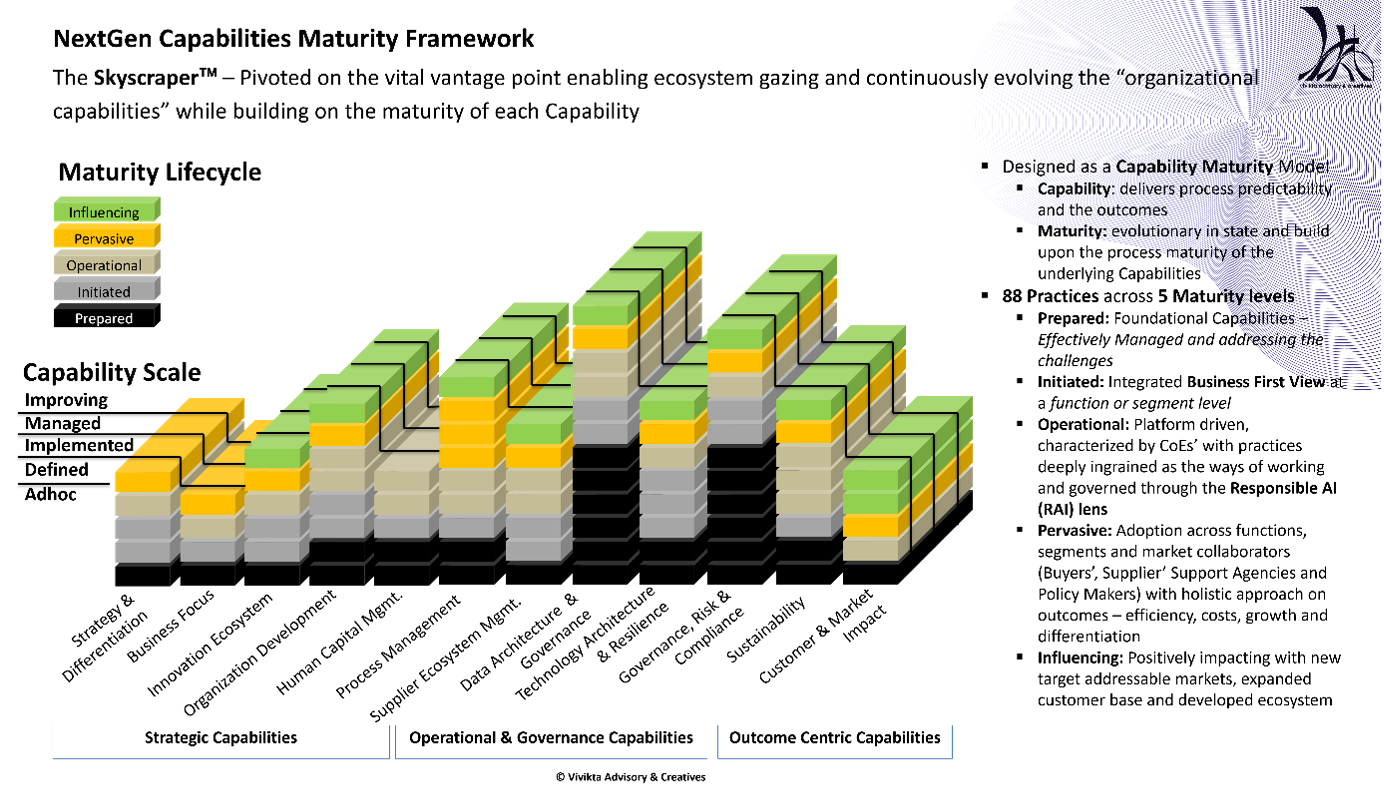
Importantly, HR should not own this journey alone. It requires partnership across the CEO, CIO, legal, risk, security, compliance, enterprise architects and business leadership teams. But HR is uniquely positioned to make the transformation stick, because organizational behavior becomes real through people practices.
The question that matters most
The most important HR question in the AI era is not, “How many roles can be automated?” It is, “How do we redesign the organization so that people and AI together create value without compromising trust?”
That question is more demanding, but it is also more strategic. It pushes leaders to move beyond tools and toward maturity. It elevates HR from a support function to a governance partner. And it reminds the business that long-term AI success will depend less on the brilliance of models and more on the quality of organizational design surrounding them.
The AI-first enterprise will not be defined only by how much technology it adopts. It will be defined by how thoughtfully it redesigns work, leadership, accountability, and culture around that technology.
That is why the CHRO’s role is expanding. Not merely to manage talent, but to help architect an organization where innovation can move fast without breaking trust.


