



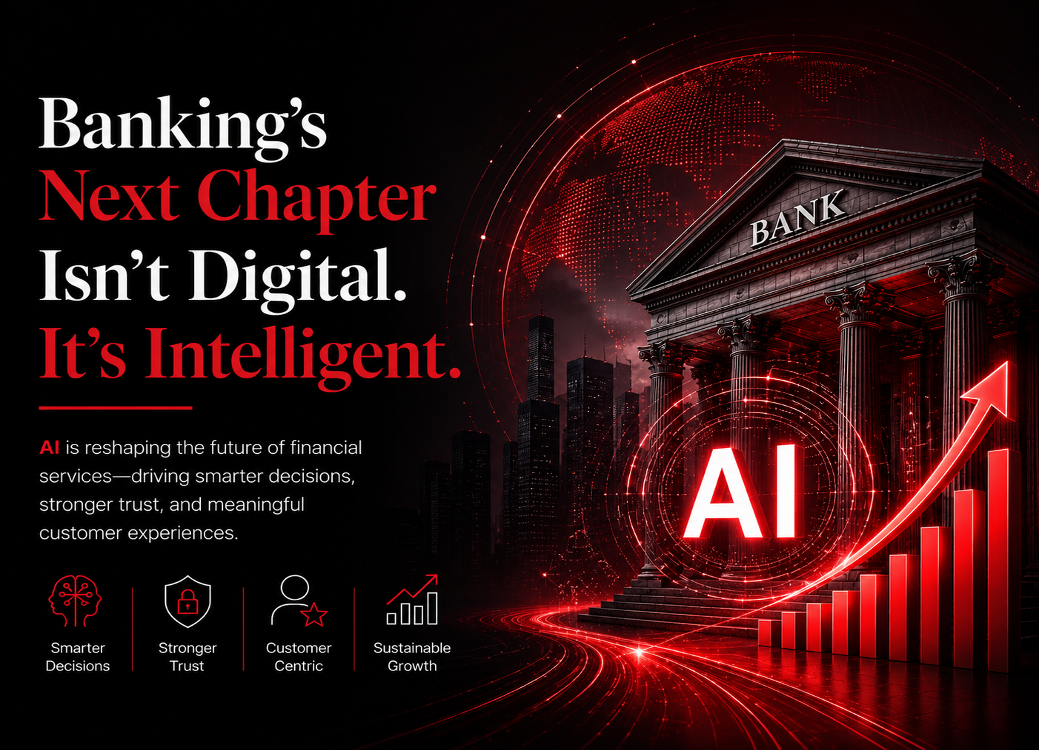
For years, the banking industry has focused on digital transformation. Mobile apps, internet banking, online onboarding, and cloud adoption have transformed the customer experience.
Yet despite these investments, many financial institutions continue to face familiar challenges: manual processes, fragmented technology ecosystems, rising compliance costs, operational inefficiencies, and increasing customer expectations.
The truth is that digital transformation alone is no longer enough.
The next decade of banking will be defined not by digitization, but by intelligence.
We are entering an era where Artificial Intelligence is becoming the operating system of modern financial institutions. The organizations that thrive will be those that successfully combine human expertise, data intelligence, automation, and predictive decision-making into a single ecosystem.
Today, customers expect banking experiences that are as seamless as ordering a product online or booking a ride through a mobile application. They want instant onboarding, real-time approvals, personalized recommendations, and proactive support.
Traditional banking infrastructures were never designed to meet these expectations.
This is why we are seeing a growing shift toward AI-powered banking ecosystems.
Across the industry, intelligent document processing is eliminating manual verification efforts. AI-driven onboarding platforms are accelerating customer acquisition while strengthening compliance. Advanced analytics are helping institutions identify risks before they become threats. Automation is reducing operational bottlenecks that once consumed significant resources.
Perhaps the most significant change is the evolution of decision-making itself.
For decades, financial institutions relied heavily on historical reports and manual reviews. Today, AI has the ability to process thousands of data points in seconds, enabling organizations to make faster, smarter, and more accurate decisions.
The future bank will not simply process transactions.
It will understand customer behavior.
It will anticipate needs.
It will identify opportunities and risks in real time.
It will continuously learn and improve.
One area where this transformation is particularly visible is fraud prevention and risk management.
As digital transactions increase, fraud techniques are becoming more sophisticated. Traditional rule-based systems are no longer sufficient to address modern threats.
The next generation of fraud management solutions combines machine learning, behavioral analytics, pattern recognition, and predictive intelligence to detect anomalies before financial damage occurs.
Financial institutions are increasingly investing in intelligent fraud governance platforms capable of monitoring vast volumes of transactions while continuously adapting to emerging risks.
This shift from reactive fraud management to predictive fraud intelligence will become a defining characteristic of future-ready banks.
At the same time, regulatory compliance remains one of the industry’s greatest challenges.
Know Your Customer (KYC), Anti-Money Laundering (AML), risk assessment, and audit requirements continue to grow in complexity. However, AI is enabling institutions to transform compliance from a resource-intensive obligation into a strategic advantage.
Automated verification, intelligent monitoring, real-time risk scoring, and digital audit trails are helping institutions strengthen governance while improving operational efficiency.
The result is not simply faster compliance.
It is smarter compliance.
Another trend that excites me is the emergence of AI-powered enterprise ecosystems within financial institutions.
Rather than operating multiple disconnected systems for onboarding, lending, document management, customer servicing, compliance, and analytics, organizations are moving toward integrated platforms where data flows seamlessly across the entire customer lifecycle.
This creates a unified intelligence layer that empowers every department from customer service and operations to risk management and executive leadership.
The future belongs to institutions that can transform data into actionable intelligence.
Looking ahead, I believe the financial services industry will witness the rise of what I call “Invisible Banking.”
Customers will no longer think about technology, processes, or paperwork.
They will simply experience outcomes.
Accounts will be opened in minutes.
Loans will be processed with greater speed and accuracy.
Fraud risks will be identified before transactions are completed.
Compliance will operate continuously in the background.
And AI-powered assistants will help customers make better financial decisions every day.
The institutions that embrace this vision today will become the market leaders of tomorrow.
Banking’s future is not about having more technology.
It is about having smarter technology.
It is not about automating individual tasks.
It is about creating intelligent organizations capable of learning, adapting, and evolving.
The next chapter of banking has already begun.
And for the first time in the industry’s history, intelligence not infrastructure will be the defining competitive advantage.


